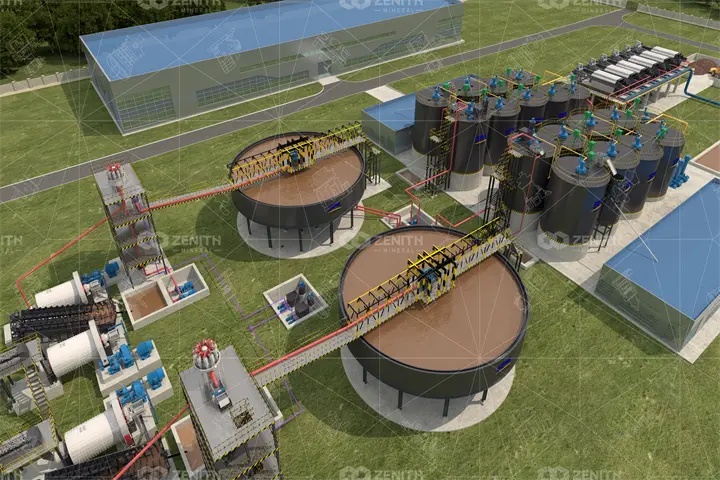
Carbon-in-Leach, or CIL, is a gold recovery method that mixes leaching and carbon adsorption in one flow. It helps recover fine gold with a simpler plant layout. For many ore bodies, it gives stable recovery, easier control, and less gold loss in tailings.
ZENITH designs complete CIL gold processing plants for new projects and plant upgrades. We match crushing, grinding, leaching, adsorption, and recovery into one workable system. That means one solution, one line, and one support team.
CIL means Carbon-in-Leach. The slurry enters leach tanks after crushing and grinding. Cyanide solution dissolves gold from the ore. At the same time, activated carbon adsorbs the dissolved gold. This dual action is the key point.
Here is the flow. First, the ore is crushed to a size that the mill can handle. Next, the mill makes fine slurry. Then, the slurry moves into leach tanks with cyanide and lime. After that, activated carbon captures gold ions. In the end, loaded carbon goes to elution and electrowinning, and the stripped carbon returns to the circuit.
Why does this matter? Because CIL reduces the time between gold dissolution and gold capture. So the dissolved gold has less chance to be lost. Also, the plant needs fewer separate adsorption tanks than a CIP-only line.
A CIL plant is only as strong as its front-end crushing and grinding section. The following ranges are common in mineral processing practice, and they guide layout, power, and recovery. They also help the plant stay safe and stable.
| Item | Typical range | Why it matters |
|---|---|---|
| Primary crushing ratio | 3:1 to 6:1 | It reduces ore size fast and protects the mill from oversize feed. |
| Secondary crushing ratio | 3:1 to 5:1 | It makes feed more even, so grinding load is easier to control. |
| Crusher cavity type | Coarse, medium, or fine | It matches ore hardness and target top size. Wrong cavity causes high wear. |
| CSS / OSS | CSS 10–50 mm, OSS depends on model | CSS is the closed side setting. OSS is the open side setting. They control product size and capacity. |
| Crusher speed | Commonly 200–350 rpm for cones | Speed affects choke feed, product shape, and liner wear. |
| Mill speed | 65% to 78% of critical speed | It keeps grinding efficient without excessive power draw. |
| Mill power | Depends on feed, usually hundreds to thousands of kW | Power must match ore hardness, throughput, and target P80. |
| Throughput | 10 t/h to 500+ t/h | It defines tank count, carbon loading, and total plant size. |
| Leach grind size | Often P80 75 µm to 106 µm | Fine liberation helps gold dissolve faster and adsorb better. |
Simple check rule: if gold is locked in coarse particles, CIL will not fix that alone. You need better liberation first. So, the right crush size and grind size come before tank design.
Quick calculation example: if feed is F80 300 mm and final grind is P80 75 µm, the size reduction is very large. That means you need staged crushing and enough mill power. If the ore is hard, a small mill will not keep recovery stable. So, capacity must follow ore test data, not guesswork.
The best CIL line depends on ore hardness, gold liberation, clay content, and climate. The wrong choice can raise cyanide use, carbon loss, and downtime. So, the selection step is very important.
| Ore condition | Suggested equipment line | Why this choice works |
|---|---|---|
| Hard quartz vein ore | Jaw crusher + cone crusher + ball mill + CIL tanks | It handles high hardness and makes stable fine feed. |
| Oxide ore with low clay | Jaw crusher + ball mill + CIL tanks | It keeps the flow simple and lowers equipment count. |
| Fine free-milling gold | Crusher + grinding + gravity pre-recovery + CIL | Gravity catches coarse gold early, so CIL treats less gold loss. |
| High clay or sticky ore | Washing, screening, then crushing and CIL | It prevents screen blinding and tank settlement problems. |
| Cold climate site | Insulated tanks, heating loop, automated dosing | It keeps leaching speed stable when temperature drops. |
Decision tree: if the ore is hard, start with staged crushing. If gold is fine, add CIL. If gold is coarse, add gravity first. If clay is high, add washing first. This order saves money and gives a cleaner process route.
More cyanide does not always mean more gold recovery. In many plants, the real problem is poor grind size or bad carbon movement. Sometimes, the slurry is too coarse, and gold stays locked in rock. Sometimes, carbon does not mix well, and dissolved gold leaves the tank.
The fix is not only chemistry. It is also mechanical. Check grind size, slurry density, oxygen supply, carbon screening, and agitation speed. When these points stay in balance, leaching becomes more stable. And then cyanide use can go down, not up.
Carbon loss often comes from weak screens, wrong tank hydraulics, or poor maintenance. Fine carbon can escape with tailings if the screen opening is too large. It can also break when the pump shear is too high. So, the tank design and pump choice both matter.
We usually add proper carbon retention screens, carbon transfer pumps, and clear maintenance access. This makes carbon movement smooth. It also makes inspection easier for operators. In practice, small screen changes can protect a lot of gold value.
Cold weather slows leach speed. Thin air can also reduce oxygen transfer. Both issues can hurt recovery. That is why site climate should enter the design stage, not the last stage.
For these sites, we recommend insulated tanks, stronger agitation, dosing control, and heat support where needed. At high altitude, we also review pump NPSH, slurry transfer head, and motor margin. This helps the plant stay steady in real field conditions.
Ore type: oxide gold ore with low sulfide content. Climate: hot and dry, with large day and night temperature swings. Feed grade: 1.6 g/t Au. Feed size after crushing: P80 12 mm. Grind target: P80 80 µm. Main line: jaw crusher, cone crusher, ball mill, and 10 CIL tanks.
Original run data before upgrade: power use was uneven, and tailings gold loss was high. After the new line started, grinding stayed more stable. Recovery rose from 84.1% to 88.6%. Maintenance moved from every 10 days to every 18 days. Carbon screen cleaning became faster too.
The client said installation was easier than expected. They also said the control room was simple to learn. For them, the biggest change was not only output. It was the smoother daily work.
Ore type: hard quartz vein ore with some fine clay. Climate: cold winter, with freezing nights. Feed grade: 2.3 g/t Au. Crushing line: primary jaw crusher plus secondary cone crusher. Grinding line: ball mill with hydrocyclone classification. Leach line: 12 insulated CIL tanks.
Original run data before adjustment: the plant had high liner wear, unstable slurry density, and slow leach kinetics. After process tuning, recovery increased from 86.9% to 90.2%. Unplanned stoppage fell by 32%. Planned liner change interval moved from 21 days to 35 days. This gave the site more continuous production.
The customer feedback was clear. They liked the easier maintenance access. They also said winter production became less stressful for operators. That kind of result is what a good CIL system should do.
Cost depends on ore hardness, capacity, automation level, and tank count. However, the main value driver is recovery. A small recovery gain can add large gold value across one year. That is why project design should look at ore test results and lifetime output, not only first price.
Simple ROI example: if a plant treats 1.2 million tons per year at 1.8 g/t, then one 1% recovery gain can recover a large extra gold amount. In many cases, that extra value pays back process upgrades fast. So, the right circuit often gives better cash flow than a cheaper but weak line.
We supply complete plant design, equipment selection, drawing support, and process matching. We also provide installation guidance, commissioning help, and operator training. So, your team does not need to guess the start-up steps.
For maintenance, we plan wear parts, screen access, tank inspection points, and spare part lists. We also help you build a service schedule. That makes shutdowns shorter and more predictable. In daily work, this support saves time and protects recovery.
Q1: Is CIL better than CIP?
A: CIL mixes leaching and adsorption in one tank train. CIP adsorbs after leaching. CIL often works better for fine gold and simpler plant layouts. However, the ore test result should decide the final route.
Q2: What grind size is common for CIL?
A: Many plants target P80 75 µm to 106 µm. This helps gold liberation and adsorption. Still, the best size depends on ore texture, clay, and recovery target.
Q3: Can one plant handle both hard ore and oxide ore?
A: Yes, with a flexible crushing and grinding design. You may need different liner sets, variable mill speed, and adjusted reagent dosing. That is why custom design matters so much.
Carbon-in-Leach is a practical gold recovery method when the ore is well prepared. It works best when crushing, grinding, leaching, and adsorption stay in balance. It also works best when the plant fits the site, not the other way around.
ZENITH supplies custom CIL gold processing solutions, from front-end crushing to final gold recovery. We can match your ore, your capacity, and your climate. Send us your ore data, and we will help you build a line that runs steady, recovers more gold, and supports long-term production.
Copyright © ,ZENITH MINERALS CO.,LTD.

 whatsapp
  Online Chat 24 hours online
 Online Chat