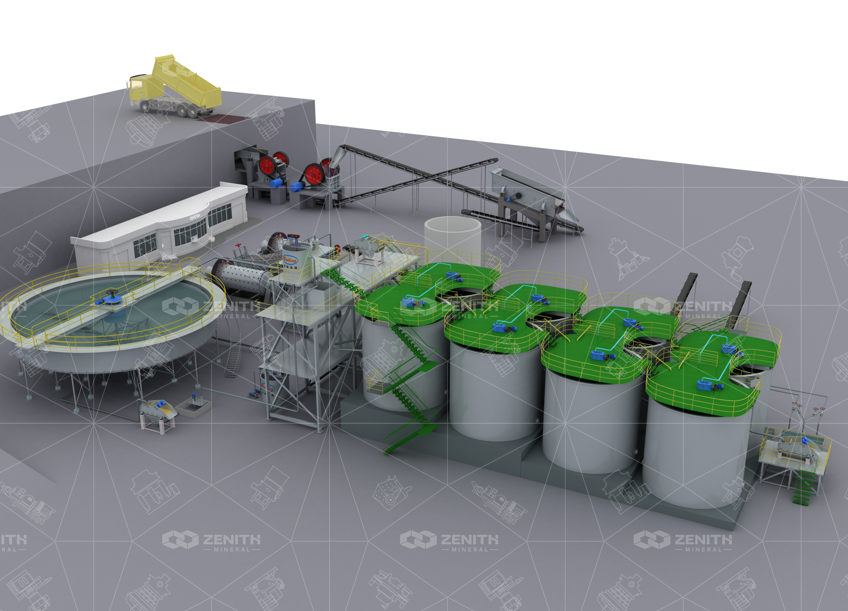
Gold mining needs smart choices. You want high recovery rates. Two main methods exist today. They are CIL and CIP. Both use cyanide. Both use activated carbon. But they work differently. ZENITH helps you choose right. We look at the details below. This guide is simple. It helps you decide.
Cyanidation dissolves gold. It turns gold into liquid. We use cyanide solution. This is standard chemistry. The reaction needs oxygen. It needs the right pH. Usually pH 10 to 11. This protects the workers. It stops gas forming.
The gold enters the water. We call this “pregnant solution”. We need to catch the gold. We use carbon for this. Carbon acts like a sponge. It sucks up the gold. The difference is when we add carbon.
CIP happens in steps. First we leach. Then we adsorb. Leaching happens in first tanks. No carbon is here. Just ore and cyanide. The gold dissolves fully here. This takes time. Usually 24 hours.
Then pulp moves to adsorption. These are separate tanks. Here we add carbon. The carbon catches dissolved gold. This method is classic. It works for simple ores. It is efficient.
CIL mixes the steps. We leach and adsorb together. Carbon is in all tanks. Or almost all tanks. As gold dissolves carbon grabs it. It happens instantly.
Why do this? Some rocks rob gold. We call this “preg-robbing”. The rock steals gold back. CIL stops this theft. Carbon is stronger than rock. Carbon wins the gold first. This boosts recovery rates.
You must crush rock first. The jaw crusher starts this. ZENITH makes strong jaw crushers. We look at the PE series. It uses a squeezing motion.
Key Specs:
The crushing ratio is big. It is about 4 to 6. The standard feed size varies. It can take 500mm rocks. The output is smaller. It is 50mm to 150mm. This is the CSS. CSS means Closed Side Setting.
Why ZENITH?
Our toggle plate is safe. It breaks if load is high. This saves the machine. The motor power matches load. It does not waste energy. The flywheel keeps speed steady.
Crushed rock is still too big. We need powder. The ball mill does this. It is a big drum. It spins with steel balls. The balls hit the rock. The rock breaks down.
Technical Data:
The speed is critical. It runs at 70% critical speed. This lifts balls high. They drop with force. We call this impact grinding. The output is fine. It is 200 mesh. This is 74 microns. This size releases gold. According to Minerals Engineering journal fine grind helps leaching.
Power Usage:
ZENITH optimizes the motor. We use air clutch sometimes. This starts the mill smooth. It lowers grid shock. The liner protects the shell. We use rubber or steel. Rubber lasts long for fine grinding.
Let us look at numbers. This table shows differences. It helps you compare quickly.
| Feature | CIP (Carbon In Pulp) | CIL (Carbon In Leach) |
|---|---|---|
| Process Steps | Leach then Adsorb | Simultaneous |
| Tank Count | More tanks needed | Fewer tanks usually |
| Carbon Load | High concentration | Lower concentration |
| Gold Recovery | Good for clean ore | Best for carbonaceous ore |
| Capital Cost | Slightly Higher | Lower (Less space) |
Many clients ask this. You mine hard. But gold is missing. The tailings grade is high. This hurts profits. Why does it happen. It is often “preg-robbing”.
The Solution:
Natural carbon in ore is bad. It acts like activated carbon. It steals your dissolved gold. If you use CIP this happens. The gold sits in tanks. The bad rock takes it. You lose gold to waste.
Switch to CIL. ZENITH engineers suggest this. In CIL we add active carbon. Our carbon is fresh. It is very active. It grabs gold faster than rock. This stops the theft. Your recovery goes up. It can rise by 20%.
Carbon is expensive. You do not want to lose it. But mixing breaks carbon. This creates “fines”. Fine carbon has gold. If it flows out you lose money.
The Fix:
We use gentle agitators. ZENITH uses modern impellers. They move pulp slow but well. They do not smash carbon. We also use good screens. Interstage screens keep carbon back. Our screens resist blocking.
We check screen size. The gap is vital. It must be smaller than carbon. But larger than ore. Usually 0.6mm or 0.8mm. This balance keeps gold safe.
Background:
A client in Sonora. The ore was oxide. It was clean ore. No preg-robbing here. The capacity was 1000 tons daily. They wanted low cost.
Equipment List:
– ZENITH Jaw Crusher PE750.
– ZENITH Cone Crusher HPT300.
– Two Ball Mills Ø2400.
– Leaching Tanks (6 stages).
– Adsorption Tanks (6 stages).
Design Logic:
We chose CIP. Why CIP. Because ore was clean. Leaching time was long. We needed 36 hours. CIP separates the steps. It was easy to manage. The silver content was high too. CIP handles silver well.
Customer Feedback:
The manager was happy. “ZENITH setup was fast” he said. The mill runs smooth. Recovery is 92%. They like the local support. Spare parts come quick.
Background:
This site was tough. The ore had graphite. Graphite is carbon. It is a preg-robber. The old plant failed. Recovery was only 60%. They called ZENITH.
The Change:
We designed a CIL plant. We removed old tanks. We installed high-lift agitators. We added carbon screens to all tanks. The carbon density is 15g/L. This is high.
Operational Data:
The grind is P80 = 200 mesh. Cyanide is 300ppm. The residence time is 24 hours. The active carbon wins. It beats the graphite.
Result:
Recovery jumped to 85%. The client made profit. “The CIL difference is real” the owner noted. Maintenance is simple. ZENITH trained their team well. We taught them safety too.
Buying is step one. Installing is step two. ZENITH sends engineers. We check the foundation. Concrete must be cured. We align the motor. Laser alignment is used. This stops vibration.
Maintenance Plan:
– Check liners weekly. Change if thin.
– Lube the bearings. Use correct grease. Why. Heat kills bearings.
– Clean the carbon screens. Blocked screens stop flow.
– Test safety valves. Cyanide is dangerous.
We provide a manual. It is easy to read. Your team will learn fast.
Money matters most. CIL saves space. You build fewer foundations. This lowers civil cost. The factory footprint is smaller. This helps in tight spots.
CIP costs more to build. You need more tanks. But operating cost varies. CIP carbon inventory is lower. CIL needs more carbon inventory.
Return on Investment:
Look at recovery. A 5% gain is huge. It pays for equipment fast. Usually in 6 months. Do not buy cheap machines. Cheap machines break. Downtime kills ROI. ZENITH machines run long. This is real value.
1. Which method uses more cyanide?
They are similar. Consumption depends on ore. Copper eats cyanide. Iron eats cyanide. The method CIL or CIP matters less. We test your ore first.
2. Can I switch from CIP to CIL later?
Yes you can. ZENITH can retrofit. We add screens to leach tanks. We change piping. It is not too hard. Many mines do this upgrade.
3. How long does the carbon last?
Carbon is tough. But it wears down. You lose about 2% to 5% per cycle. You need to add fresh carbon. We also regenerate old carbon. A kiln burns off dirt. ZENITH supplies kilns too.
Copyright © ,ZENITH MINERALS CO.,LTD.

 whatsapp
  Online Chat 24 hours online
 Online Chat