You spend massive money crushing and grinding gold ore. You buy expensive cyanide. You buy top grade activated carbon. Then you test the tailings. The gold grade in the waste is just way too high.
Whether the ore comes from a fresh underground deposit or a weathered open-pit operation, the objective remains the same: reduce the rock to the right particle size while maintaining throughput, controlling operating costs, and protecting downstream circuits.
You are throwing money away every hour. What is actually going wrong.
Alot of plant managers blame the chemicals. They add more cyanide. They pump in more oxygen. But the real thief is mechanical.
Look at your CIL tanks. The agitator inside is probably killing your profit.
If the impeller spins too fast it acts like a giant blender. It hits the activated carbon hard and breaks it into tiny dust. These carbon fines are loaded with your gold. But they are way too small for the inter-tank screens to catch. So they just wash straight out into the tailings dam.
But if you slow down a normal agitator you get a different nightmare. The heavy sand settles at the bottom. You get massive dead zones. The ore never touches the cyanide. The tank volume shrinks and the slurry just short circuits right through.
So you have a choice. Break the carbon or bury the tank in sand. Both cost you big money.
We see this mess all the time at ZENITH. We designed our CIL agitation tanks exactly to stop this problem. We dont use standard flat impellers.
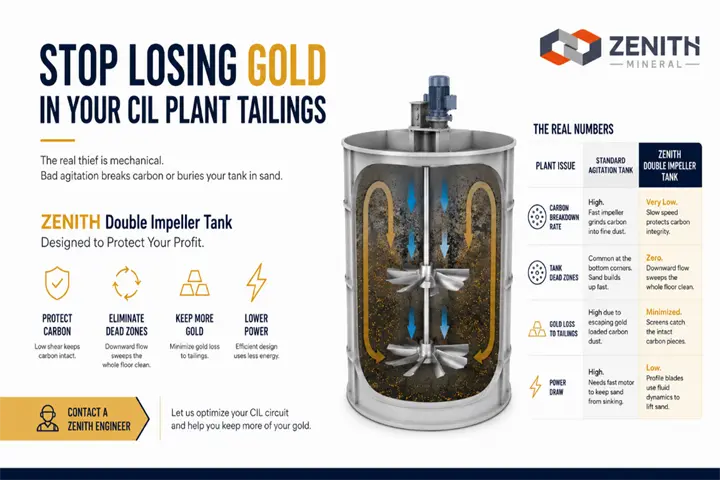
ZENITH uses a special double impeller design. The blades are pitched at a specific angle. They push the heavy slurry straight down to the tank floor. Then the flow sweeps up along the tank walls. This creates a massive slow circulation loop.
It keeps all the heavy solids perfectly suspended. But the rotation speed is much lower than normal tanks. Low speed means low shear force. The impeller blades do not smash the carbon. Your activated carbon stays in big strong pieces. The screens catch it easily.
Your gold stays in the plant instead of going to the waste dump. Plus a slower motor uses less electricity.
Here is what happens when you swap a standard agitator for a ZENITH double impeller tank.
| Plant Issue | Standard Agitation Tank | ZENITH Double Impeller Tank |
|---|---|---|
| Carbon Breakdown Rate | High. Fast impeller grinds carbon into fine dust. | Very Low. Slow speed protects carbon integrity. |
| Tank Dead Zones | Common at the bottom corners. Sand builds up fast. | Zero. Downward flow sweeps the whole floor clean. |
| Gold Loss to Tailings | High due to escaping gold loaded carbon dust. | Minimized. Screens catch the intact carbon pieces. |
| Power Draw | High. Needs fast motor to keep sand from sinking. | Low. Profile blades use fluid dynamics to lift sand. |
Dont let bad mechanical design steal your gold. Contact a ZENITH engineer today. We will look at your slurry density and tank sizes. We can fix your CIL circuit so you keep the gold you worked so hard to mine.
Copyright © ,ZENITH MINERALS CO.,LTD.

 whatsapp
  Online Chat 24 hours online
 Online Chat