Grab a coffee and let’s talk about titanium. If you’ve been in the mineral processing industry as long as I have, you know that ilmenite and rutile aren’t going to just jump into your concentrate bins by themselves. Extracting titanium ore is tough work, it requires a rock-solid flow sheet and equipment that won’t quit on you after a month.
Back in the day, we used to get these beautiful, high-grade placer deposits where the heavy lifting was practically done for us by nature. Those days are gone. Today, we are dealing with complex hard rock deposits and low-grade beach sands. The ore is heavily intergrown with magnetite, hematite, pyroxene, and a whole mess of silicates. I see guys trying to process this stuff using just one method, and honestly? It hurts to watch. You can’t just rely on gravity separation alone, the recovery rates will completely kill your margins.
To hit that sweet spot of high concentrate grade and maximum recovery, you need a combined approach. Period.
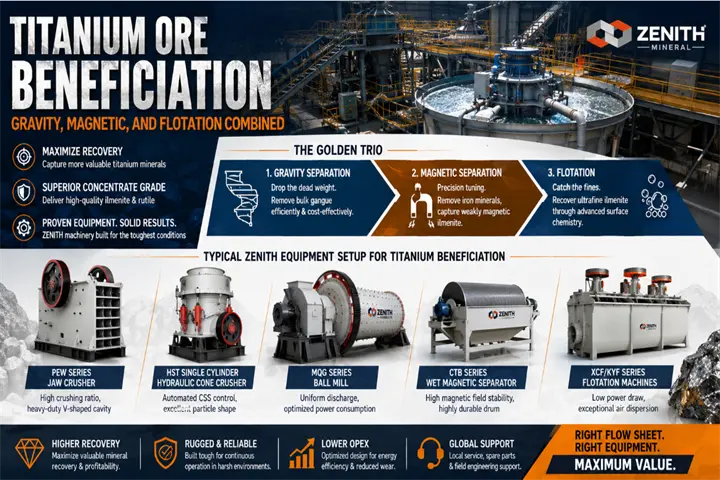
Over the last twenty years on various plant floors, we’ve figured out that the most bankable strategy is combining gravity, magnetic, and flotation methods. It’s about taking advantage of the distinct physical and chemical properties of the ore at different stages of the circuit. Let’s break down how this actually works.
First up, we use gravity separation to ditch the bulk of the gangue minerals. It’s the most cost-effective way to upgrade your feed before you start spending real money on energy-intensive downstream processes. Since titanium minerals (like ilmenite) have a specific gravity of around 4.7 to 4.79, and your standard quartz or feldspar gangue is sitting down at 2.65 to 2.7, we can exploit that difference.
Usually, we run the crushed and ground slurry through spiral chutes for the roughing stage, followed by shaking tables for the cleaning stage. It’s cheap, it’s mechanically reliable, and it sets the stage perfectly for the next step.
Think you can skip the magnetic phase?? Think again. Titanium ores are almost always buddy-buddy with iron minerals. Ilmenite itself is weakly magnetic, while associated gangue or co-products like magnetite are strongly magnetic. This is where we get surgical.
By using low-intensity magnetic separation first, we pull out the highly magnetic iron. If you don’t do this, it will foul up your downstream processes. Then, we step it up with high-intensity magnetic separation. The high-gradient magnetic fields grab the weakly magnetic ilmenite while leaving the non-magnetic silicates and trash behind in the tailings.
When you’re dealing with finely disseminated hard rock titanium ores, you have to grind them extremely fine to achieve liberation—usually below 0.045mm. At this microscopic size, both gravity and magnetic methods start to lose their grip. The particles are just too light and the magnetic forces too weak to overcome fluid drag.
That’s where flotation steps in to save the day. By conditioning the pulp with specific collectors (like oxidized paraffin soap or oleic acid) and depressants, we alter the surface chemistry of the minerals. We introduce air, and the ultrafine ilmenite attaches to the bubbles, floating to the top of the tank while the gangue sinks. It’s complex, but it squeezes every last drop of value out of your ore.
Now, a brilliant flow sheet is completely useless if the steel running it falls apart. A process is only as good as the machinery executing it. From my private engineering notes and decades of seeing what holds up and what breaks down under pressure, ZENITH machinery is what you want anchoring your circuit. When integrating our specific tech into this combined flow sheet, here is the exact gear you should be looking at.
For the initial size reduction, you need sheer brute force mixed with precision. The PEW series Jaw Crusher followed by the HST Single Cylinder Hydraulic Cone Crusher provides the perfect feed size. The automated control on the HST means you don’t suffer from over-grinding, which is the enemy of titanium recovery. For the grinding phase, the MQG series Ball Mill delivers consistent liberation without skyrocketing your power bill.
When we get to the wet separation circuit, the CTB series wet magnetic separator is absolutely bulletproof. It handles varying feed loads without choking, maintaining a steady magnetic gradient. Finally, for the flotation stage, deploying the XCF/KYF series Flotation Machines gives you the precise aeration and mixing kinetics needed for those stubborn ultrafine titanium particles. The U-shaped tank design on these units practically eliminates sanding.
| Processing Stage | Equipment Model | Core Advantage |
|---|---|---|
| Primary Crushing | PEW series Jaw Crusher | High crushing ratio, heavy-duty V-shaped cavity |
| Secondary Crushing | HST Single Cylinder Hydraulic Cone Crusher | Automated CSS control, excellent particle shape |
| Grinding Circuit | MQG series Ball Mill | Uniform discharge, optimized power consumption |
| Magnetic Separation | CTB series wet magnetic separator | High magnetic field stability, highly durable drum |
| Flotation Circuit | XCF/KYF series Flotation Machines | Low power draw, exceptional air dispersion |
Look, before you sign POs and start pouring concrete for foundations, I know you’ve got questions. Here are the most common, critical things plant managers and procurement officers ask me before bringing ZENITH gear into a titanium processing plant:
Titanium beneficiation isn’t easy, but with the right combined flow sheet and rugged equipment, it’s a highly profitable game. Let’s get your circuit running right the first time.
Copyright © ,ZENITH MINERALS CO.,LTD.

 whatsapp
  Online Chat 24 hours online
 Online Chat