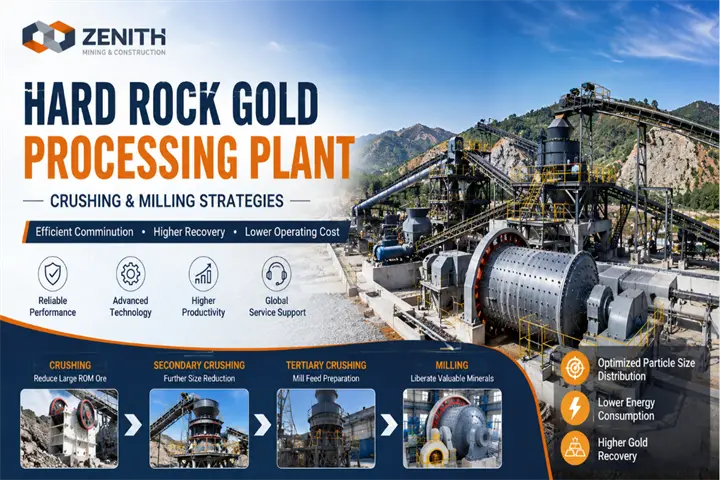
In hard rock gold mining, the real battle often starts long before gold recovery. It starts at the crushing and milling stage. Many plant owners focus heavily on downstream recovery equipment, but experienced operators know that poor feed preparation can quietly reduce recovery rates, increase power consumption, and drive maintenance costs through the roof.
Whether the ore comes from a fresh underground deposit or a weathered open-pit operation, the objective remains the same: reduce the rock to the right particle size while maintaining throughput, controlling operating costs, and protecting downstream circuits.
Hard rock gold ore is typically associated with quartz veins, sulfides, and highly abrasive host rocks. These materials place tremendous stress on crushing equipment. A poorly designed crushing circuit can create excessive fines, increase liner wear, and generate bottlenecks throughout the plant.
The most successful operations usually follow a staged reduction approach rather than trying to achieve final size reduction in a single step. This not only improves efficiency but also extends the service life of critical components.
A typical hard rock gold crushing circuit may include:
Skipping proper classification is a mistake we still see in some projects. It looks cheaper on paper, but six months later the milling department is usually paying the price.
For many medium and large-scale gold processing plants, ZENITH equipment can be configured to create a balanced and efficient comminution circuit. The exact selection depends on ore hardness, moisture content, plant capacity, and final product requirements.
| Stage | Main Objective | Target Product Size |
|---|---|---|
| Primary Crushing | Reduce large ROM ore | 100-250 mm |
| Secondary Crushing | Further size reduction | 30-80 mm |
| Tertiary Crushing | Mill feed preparation | 10-25 mm |
The key is not simply achieving a smaller product size. The goal is generating a consistent feed that allows the milling circuit to operate at maximum efficiency. Consistency matters. Actually, it matters more than many people realize.
After crushing, the ore enters the milling circuit. This is usually the most energy-intensive section of a gold processing plant. In some operations, milling can account for more than half of total power consumption.
That is why plant designers spend significant time optimizing mill feed size. Every millimeter removed during efficient crushing reduces the energy required in grinding.
Common milling objectives include:
A well-operated milling circuit should balance throughput and liberation. Grinding too coarse leaves valuable gold locked in the rock. Grinding too fine creates unnecessary power costs and can complicate downstream recovery.
One of the biggest mistakes in plant design is treating crushing and milling as separate departments. They are part of the same system.
When the crushing circuit produces excessive oversize material, mill performance suffers. When the crusher generates too many fines, screening efficiency declines and wear rates increase. The best plants evaluate the entire comminution chain as a single integrated process.
Successful operators typically monitor:
These metrics tell the real story. Not the nameplate capacity printed in a brochure.
Before investing in a hard rock gold processing plant, engineering teams should carefully evaluate ore characteristics through laboratory and pilot-scale testing. The hardness of the ore, abrasiveness index, clay content, moisture level, and expected throughput all influence equipment selection.
| Factor | Operational Impact | Design Consideration |
|---|---|---|
| Ore Hardness | Higher power demand | Crusher and mill sizing |
| Abrasiveness | Wear component consumption | Liner material selection |
| Moisture Content | Material handling issues | Screening design |
| Plant Capacity | Equipment configuration | Circuit layout planning |
A little extra engineering work at the beginning can prevent years of operational headaches later. We’ve seen that happen more than once??
For hard rock gold processing plants, efficient crushing and milling are the foundation of profitable production. A properly engineered comminution circuit reduces energy consumption, minimizes downtime, improves equipment life, and ultimately increases gold recovery.
By integrating well-designed crushing stages with an optimized milling circuit, mining companies can achieve stable performance even under demanding ore conditions. The result is a plant that not only meets production targets but also maintains long-term operational reliability and cost efficiency.
Wear life depends on ore abrasiveness and operating conditions. Regular monitoring and optimized feed distribution significantly extend liner life.
Yes. Equipment selection and circuit design should always be based on ore testing results and production requirements.
Most industrial crushing and milling systems can be configured to meet local voltage and frequency requirements.
Many international suppliers provide on-site installation guidance, commissioning support, and operator training.
Delivery schedules vary according to project scale, customization level, and manufacturing workload, but early planning helps reduce lead times.
Extremely important. Fast access to critical wear parts helps minimize downtime and maintain production continuity.
A modular plant design allows future capacity increases with lower investment and reduced operational disruption.
Consistent ore preparation. Proper crushing and grinding directly influence mineral liberation and downstream recovery efficiency.
Copyright © ,ZENITH MINERALS CO.,LTD.

 whatsapp
  Online Chat 24 hours online
 Online Chat